Syllabus Aims…
6.8 know that an electric current in a conductor produces a magnetic field around it
6.9P describe the construction of electromagnets (Triple)
6.10P draw magnetic field patterns for a straight wire, a flat circular coil and a solenoid when each is carrying a current (Triple)
6.11P know that there is a force on a charged particle when it moves in a magnetic field as long as its motion is not parallel to the field (Triple)
6.12 understand why a force is exerted on a current-carrying wire in a magnetic field, and how this effect is applied in simple d.c. electric motors and loudspeakers.
6.13 use the left-hand rule to predict the direction of the resulting force when a wire carries a current perpendicular to a magnetic field.
6.14 describe how the force on a current-carrying conductor in a magnetic field increases with the magnitude and direction of the field and current.
Resources…
Use these PowerPoints for a ideas and resources…
6C Electro Magnetism 2 to 4 Part 1
6C Electro Magnetism 5 to 7 Part 2
Useful Videos…
Fleming's left hand rule, the motor rule - explained with demo: from fizzics.org
Electromagnetic Bell
How an electromagnetic bell works.
This is a nice application of a simple magnetic principle. The bell is not specifically in the Edexcel IGCSE syllabus, but that doesn't mean a question ...couldn't be asked on it.Show More Relay - Explained and animated - how relay works
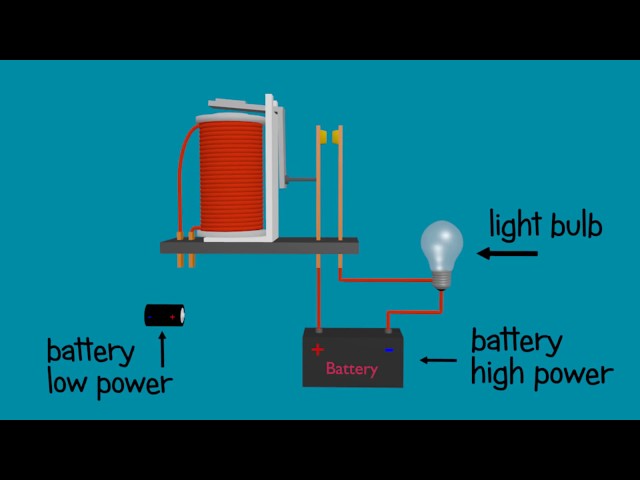
Relay - Explained and animated
A relay is an electrically operated switch. Many relays use an electromagnet to mechanically operate a switch, but other operating principles are also used, such ...as solid-state relays. Relays are used where it is necessary to control a circuit by a separate low-power signal, or where several circuits must be controlled by one signalShow More Alarm bell example of Electromagnets
How does an alarm bell work? Watch the slow motion video?
Bimetallic Circuit Breaker GCSE Physics
This is a great video to show a thermal circuit break works and bimetallic strip function. Both are required concepts for GCSE Physics for Mechanical Circuit Breakers or MCBs
Motor Effect
Simple demonstration of the Motor Effect or FBI Flemings Lefthand rule.
Soundwaves on an oscilloscope
Simple demo of a human voice and whistling on an LCD oscilloscope to show how pure notes and complex waves are formed.
The physics principles behind a speaker
A short video that explains the physics of a speaker and how it relates to the motor effect (Lorentz force)
CORRECTION: A number of comments stated there is only one magnet ...(not two as stated)
That is true. The ring magnet has a top and bottom polarity, that with the plates (a center plate and a top plate) set up one polarity on the outside and the the other polarity on the inside pole)
So apologies for my error on the magnet itself. However, the explanation of its working is nonetheless correct.
👍 Really like this video?
Support by buying me a coffee ☕️ - http://www.buymeacoffee.com/physicshigh
Subscribe - http://www.youtube.com/c/physicshigh
LIKE and SHARE with your peers. And please add a COMMENT to let me know I have helped you.
Support my work either regularly at Patreon: http://www.patreon.com/Physicshigh
OR
a one off payment at PayPal: pelooyen@gmail.com
Physics High is committed to producing content that teaches physics concepts at a level a high schooler can understand.
See http://www.physicshigh.com for all my videos and other resources.
👥 Social
---------------------------------------------------------
Follow me on
facebook: @physicshigh
twitter: @physicshigh
Instagram: @physicshigh
#physicshigh #highschoolphysicsexplainedShow More GCSE Physics - How the Electric Motor Works (2026/27 exams)
Electric Motor with a paperclip
This is a really simple idea, where you use a paperclip for the commutator for an electrical motor demo.
It is so easy to bend around and make it spring back, ...so the connection is very firm to do.
Works so well you should convert your whole set!Show More