22 Electric Fields
This page covers the electrical fields section of the course.
Resources
22 Electric Fields Student Booklet
22 Electric Fields
Semolina and Electric Fields
22.4 Coulomb Law Challenge Questions
pHet Fields Worksheet
22.5 Uni Level Problems
https://phet.colorado.edu/sims/html/charges-and-fields/latest/charges-and-fields_en.html
Electric Field - Christmas Candle Flame - AQA A Level Physics
When the E.H.T. power supply is switched on, the candle flame splits into two portions in opposite directions.
The hot flame of the candle ionises the air molecules in its ...surrounding into positive and negative ions.
The positive ions are heavier and move much slower. Thus, a larger portion of the flame follows the positive ions, moving towards the negative plate.
The negative charge are electrons and are very much lighter than the positive ions. They move faster towards the positive plate and more easily.
Thus, the portion of the flame that follows the negative ions are much smaller and thinner. This practical really does need a 25kV supply to work well.
Also in a uniform electrical field the electrical field strength (Vm-1) is E∝𝑉/𝑑 so when we move the electrodes closer they put out the flame as E∝1/𝑑 as the field strength is stronger.
At the end we can see the soot on the negative electrode due to the ions from the flame.
It's a great demo for separation of ions and electrons and evidence if charged ions. Also clearly the mass of the positive is more not that there are more, slip of the tongue!
The demo is dangerous so you must take care and no pupils close to it. My EHT is current limited for safer use in schools.
Finally the video has one error when I talked about the ions there are clearly the same POS and negative ones. The masses are the differences.
Lastly it's quite hard to get the flame to go out, I was lucky...so don't be disappointed if you fail!Show MoreElectric Field - Christmas Candle Flame - AQA A Level Physics
When the E.H.T. power supply is switched on, the candle flame splits into two portions in opposite directions.
The hot flame of the candle ionises the air molecules in its ...surrounding into positive and negative ions.
The positive ions are heavier and move much slower. Thus, a larger portion of the flame follows the positive ions, moving towards the negative plate.
The negative charge are electrons and are very much lighter than the positive ions. They move faster towards the positive plate and more easily.
Thus, the portion of the flame that follows the negative ions are much smaller and thinner. This practical really does need a 25kV supply to work well.
Also in a uniform electrical field the electrical field strength (Vm-1) is E∝𝑉/𝑑 so when we move the electrodes closer they put out the flame as E∝1/𝑑 as the field strength is stronger.
At the end we can see the soot on the negative electrode due to the ions from the flame.
It's a great demo for separation of ions and electrons and evidence if charged ions. Also clearly the mass of the positive is more not that there are more, slip of the tongue!
The demo is dangerous so you must take care and no pupils close to it. My EHT is current limited for safer use in schools.
Finally the video has one error when I talked about the ions there are clearly the same POS and negative ones. The masses are the differences.
Lastly it's quite hard to get the flame to go out, I was lucky...so don't be disappointed if you fail!Show More Christmas Candle in Electrical Field - Smoking and Sparking!
When the E.H.T. power supply is switched on, the candle flame splits into two portions in opposite directions. The hot flame of the candle ionises the air molecules in its ...surrounding into positive and negative ions. The positive ions are heavier and move much slower. Thus, a larger portion of the flame follows the positive ions, moving towards the negative plate. The negative charge are electrons and are very much lighter than the positive ions. They move faster towards the positive plate and more easily.
Thus, the portion of the flame that follows the negative ions are much smaller and thinner. This practical really does need a 25kV supply to work well.
Also, in a radial electrical field the electrical potential goes from positive to negative and actually seems to work pretty much the same as the uniform electrical field.
It's a great demo for separation of ions, electrons, and evidence if charged ions. Also, clearly the mass of the positive is more not that there are more, slip of the tongue! The demo is dangerous so you must take care and no pupils close to it.
My EHT is current limited for safer use in schools.Show More Electric field Pattern with Semolina
A2 electric field patterns - Amazing practical where you put high tension across castor oil, or a viscous oil.
The semolina acquires a static charge with positive and negative and line ...up as they attract end on end.
So cool!Show More Static Electricity for GCSE plastic wrapper
This always happens when I open a mint from a plastic wrap. it acquires a static charge from the friction then sticks to you by induction.
Amazing everyday Physics.
Plasma Ball and Static causing excitation of a low
Electroscope Static Dangers
This video shows how semolina falls down a long plastic tube. As it does so it acquires a static charge via friction. As the semolina grains fall into a copper ...can an electroscope is charged by the accumulation of semolina and charged grains. When you touch the can the charge leaks away. This clearly shows why we need a static wire to release charge in certain circumstances.Show More Circular Electron Beam in Magnetic Field - A Level Physics
This is how you can work out e/m for circular beam of electrons thermionic emitted from a filament.
It uses both electric fields and mag fields and Helmholtz coils.
10 Ways to SEE the ELECTRIC FIELD - Part 1
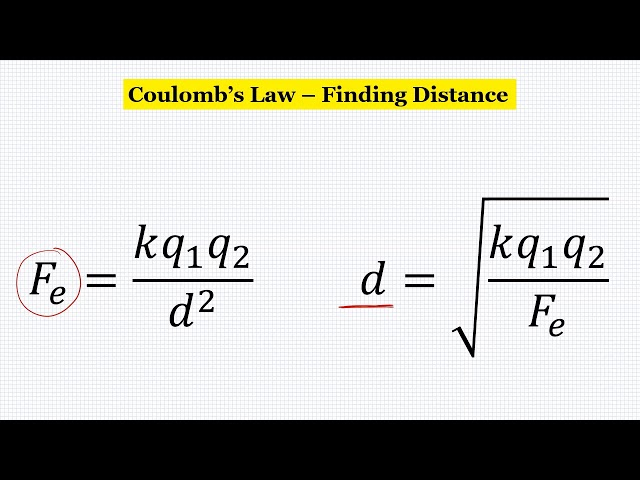
Statics - Coulomb's Law Finding Distance
In this video, I do a quick recap of Coulomb's Law and we learn how to solve for the distance between two charged objects.
Coulomb's Law (2 of 7) Calculate the Force Between Two Charges
Using Coulomb's law shows how to calculate the magitude and direction of the electric force between two charged particles. Coulomb's law states that the magnitude of the force between two ...point charges is directly proportional to the product of the magnitudes of charges and inversely proportional to the square of the distance between them. If the sign of the charges is the same, both positive or both negative, then there will be a force of repulsion between the charges. If they have the opposite sign then there will be a force of attraction between the objects. The force is along the straight line joining the two charges. The SI unit for the force is the newton.
The force between the charged bodies at rest is commonly known as the electrostatic force. Coulomb's law is an inverse-square law and is similar to Isaac Newton's inverse-square law of universal gravitation, but gravitational forces are always attractive, while electrostatic forces can be attractive or repulsive.
The law is named after the French physicist Charles-Augustin de Coulomb who first discovered it in 1785. The SI unit for electric charge was named after him.
You can see a listing of all my videos at my website, http://www.stepbystepscience.com
This video can be shared at: https://youtu.be/zaAWh4kuLjkShow More Coulomb's Law
004 - Coulomb's Law
In this video Paul Andersen explains how we can use Coulomb's law to predict the structure of atoms. These predictions can be verified through the use ...of Photoelectron Spectroscopy (PES). Electron's are help around the nucleus because of differences in charge. As the atoms become larger the charges change and so do the structures.
Music Attribution
Title: String Theory
Artist: Herman Jolly
http://sunsetvalley.bandcamp.com/track/string-theory
All of the images are licensed under creative commons and public domain licensing:
"Build an Atom." PhET. Accessed July 31, 2013. http://phet.colorado.edu/en/simulation/build-an-atom.
"File:Albert Einstein (Nobel).png." Wikipedia, the Free Encyclopedia. Accessed July 31, 2013. https://en.wikipedia.org/wiki/File:Albert_Einstein_(Nobel).png.
"File:Coulomb.jpg." Wikipedia, the Free Encyclopedia. Accessed July 29, 2013. https://en.wikipedia.org/wiki/File:Coulomb.jpg.
File:CoulombsLaw.svg, n.d. https://en.wikipedia.org/wiki/File:CoulombsLaw.svg.
"File:Electron Shell 001 Hydrogen - No Label.svg." Wikipedia, the Free Encyclopedia. Accessed July 31, 2013. http://en.wikipedia.org/wiki/File:Electron_shell_001_Hydrogen_-_no_label.svg.
"File:Electron Shell 002 Helium - No Label.svg." Wikipedia, the Free Encyclopedia. Accessed July 31, 2013. http://en.wikipedia.org/wiki/File:Electron_shell_002_Helium_-_no_label.svg.
"File:Electron Shell 003 Lithium - No Label.svg." Wikipedia, the Free Encyclopedia. Accessed July 31, 2013. http://en.wikipedia.org/wiki/File:Electron_shell_003_Lithium_-_no_label.svg.
"File:Photoelectric Effect.svg." Wikipedia, the Free Encyclopedia. Accessed July 31, 2013. http://en.wikipedia.org/wiki/File:Photoelectric_effect.svg.
File:Pointing Hand Cursor Vector.svg, n.d. http://commons.wikimedia.org/wiki/File:Pointing_hand_cursor_vector.svg.
Svdmolen/Jeanot. Helium Atom (not to Scale), converted 2007 2005. Image:Atom.png. http://commons.wikimedia.org/wiki/File:Atom.svg.Show More Gravitational & Electric Fields - A-level & GCSE Physics
http://scienceshorts.net Re-uploaded due to a couple of mistakes!
Please don't forget to leave a like if you found this helpful!
--------------------------------------------------
00:00 Field lines
01:56 Newton's law of gravitation & Coulomb's law
03:28 ...Potential energy
04:31 Field strength
07:09 Potential
09:45 Potential gradient & graphs
11:48 Parallel plates
12:59 Field strength inside planet
13:36 Field strength between masses
15:01 Resultant potential -
----------------------------------------------------------------------
I don't charge anyone to watch my videos, so please donate if you can to keep me going! https://bit.ly/scienceshortsdonateShow More Coulomb's Law (with example)
A simple, easy explanation of the intuition behind Coulomb's law and a worked example of an exam type question.
Hi! I'm Jade. I make fun physics videos that will ...make you smarter while making you smile :)
***SUBSCRIBE***
https://www.youtube.com/c/upandatom
***Let's be friends***
TWITTER: https://twitter.com/upndatom?lang=en
***RELATED VIDEOS YOU WILL LOVE***
What is Electricity? https://www.youtube.com/watch?v=oB0zHJtiSRg
How to Calculate the Force Between THREE Charges https://www.youtube.com/watch?v=R8euHjXaIcE
What is an Electric Field? https://www.youtube.com/watch?v=LDJwqxpzA7A
____________________________________________________________________
1) Coulomb's law accurately measures the size of the force between two charges. It is based on two findings: the size of the electrostatic force is directly proportional to the product of the magnitude of the charges, and the electrostatic force is inversely proportional to the square of the distance separating the charges. When these two findings are translated into a mathematical equation it takes the form F=kq1q2/r^2, where F is the force, k is Coulomb's constant, q1 and q2 are the magnitudes of the charges, and r is the distance separating the charges. This is Coulomb's law.
2) The example worked through in this video tutorial is: Two charges of magnitude 1.8 x 10^-17 C are separated by a distance of 150 nm. What is the size of the electrostatic force experienced by each charge?Show More Electric Fields - A Level Physics
A-Level Physics Electric Fields walkthrough
Permanent link to this article: https://www.animatedscience.co.uk/a-level-physics-topics/7-ks5-fields/22-electric-fields