18 Simple Harmonic Motion SHM
This is the final section of periodic motion which expands on circular motion to include more complex ideas. You must study circular motion first before you do this topic.
18 SHM Student booklet
18 SHM
V Shaped Pendulum Results
SHM Focus Education Results
Maths Skills angles
A3 slide to compare motion
SHM Data Damping
18.6 damping analysis sheet
18.6 Forced resonance results
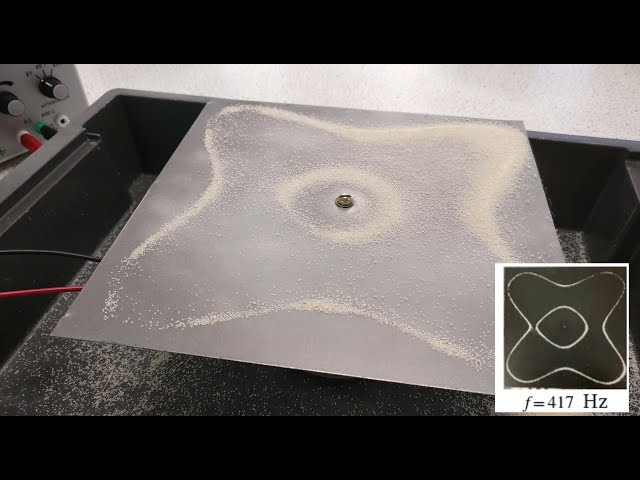
Finding the Resonant frequency in a Chladni Plate
Finding the Resonant frequency in a Chladni Plate
Chladni plate shapes, or Chladni figures, are intricate geometric patterns formed by sand (or salt/flour) on a vibrating plate, revealing standing waves of ...sound. Common shapes include symmetrical lines, curves, and complex designs like starbursts or multi-petaled forms, depending on the plate's shape (square, circular, violin) and the specific vibration frequency (pitch). The sand moves to the nodal lines (areas of zero vibration), making sound visible as art, bridging science and aesthetics.
Common Plate Shapes & Their Patterns:
Circular Plates: Tend to produce concentric rings and symmetrical patterns, with complexity increasing at higher frequencies, related to Bessel functions.
Square Plates: Can form curved lines cutting off corners, branching lines, and eventually intricate, multi-petaled forms as frequency rises.
Rectangular Plates: Simpler patterns, often linear nodes, especially when sides are in simple ratios.
Violin/Guitar Shapes: More complex, custom patterns emerge due to their unique boundaries.
How They Form:
1. Vibration: A flat plate (metal, glass) is vibrated, often by a speaker or violin bow.
2. Standing Waves: Specific frequencies cause standing waves to form, creating stable areas of maximum vibration (antinodes) and no vibration (nodes).
3. Sand Movement: Fine particles (sand, salt, flour) are scattered on the plate.
4. Pattern Creation: The sand is pushed away from the vibrating antinodes and gathers along the stationary nodal lines, revealing the invisible sound patterns.Show MoreFinding the Resonant frequency in a Chladni Plate
Finding the Resonant frequency in a Chladni Plate
Chladni plate shapes, or Chladni figures, are intricate geometric patterns formed by sand (or salt/flour) on a vibrating plate, revealing standing waves of ...sound. Common shapes include symmetrical lines, curves, and complex designs like starbursts or multi-petaled forms, depending on the plate's shape (square, circular, violin) and the specific vibration frequency (pitch). The sand moves to the nodal lines (areas of zero vibration), making sound visible as art, bridging science and aesthetics.
Common Plate Shapes & Their Patterns:
Circular Plates: Tend to produce concentric rings and symmetrical patterns, with complexity increasing at higher frequencies, related to Bessel functions.
Square Plates: Can form curved lines cutting off corners, branching lines, and eventually intricate, multi-petaled forms as frequency rises.
Rectangular Plates: Simpler patterns, often linear nodes, especially when sides are in simple ratios.
Violin/Guitar Shapes: More complex, custom patterns emerge due to their unique boundaries.
How They Form:
1. Vibration: A flat plate (metal, glass) is vibrated, often by a speaker or violin bow.
2. Standing Waves: Specific frequencies cause standing waves to form, creating stable areas of maximum vibration (antinodes) and no vibration (nodes).
3. Sand Movement: Fine particles (sand, salt, flour) are scattered on the plate.
4. Pattern Creation: The sand is pushed away from the vibrating antinodes and gathers along the stationary nodal lines, revealing the invisible sound patterns.Show More Forced Oscillation Resonance - AQA A Level Physics
See how a mass spring system has a frequency at which it oscillates freely.
Phase shift of Pendulum SHM and Circular Motion
Very cool SHM experiment. Watch to the end to find out the length of the pendulum. Use the time on the video to compare.
If you work out the cycle time ...from 1min to 1 min 14s. The ball spins around 10 times. This gives a period T = 1.4s
The string is 0.43cm long which gives a theoretical period time T = 1.32s
Interestingly if you work out the expected length to match the pendulum is should be 48.7cmShow More Lissajous Figures Part 1
Lissajous curves can be generated using an oscilloscope (as illustrated).
Two phase-shifted sinusoid inputs are applied to the oscilloscope in X-Y mode and the phase relationship between the signals is ...presented as a Lissajous figure.
In the professional audio world, this method is used for realtime analysis of the phase relationship between the left and right channels of a stereo audio signal.Show More Oscillations Demo: Mass Spring System
This demonstration investigates the dependence of the period of the mass-spring system on the mass, the spring constant, and the amplitude.
This demonstration was created at Utah State University ...by Professor Boyd F. Edwards, assisted by James Coburn (demonstration specialist), David Evans (videography), and Rebecca Whitney (closed captions), with support from Jan Sojka, Physics Department Head, and Robert Wagner, Executive Vice Provost and Dean of Academic and Instructional Services.Show More Tom Altman and SHM at the Exploriatorium
The High School Physics Project: Classic demonstrations of Simple Harmonic Motion.
Simple Harmonic Motion Visualized
An old animation.
Tools - Cinema 4D, Adobe Premiere Pro
Simple Harmonic Motion
A description of Simple Harmonic Motion, including its definition, and examples of SHM in the form of oscillating springs and pendulums.
Simple Harmonic Motion and Energy Conservation
Introduces energy conservation for simple harmonic motion problems. This is at the AP Physics level.
Energy in SHM (Total Energy = Kinetic Energy + Potential Energy) #6
In this lesson we see how the potential and kinetic energy of this system changes during time period T. And if you sum up the Potential and Kinetic Energy at ...various times, you can also establish how the total energy of the system will change.
Solved numerical problems and downloadable PDFs: ▶ https://thesciencecube.com/
Join our Telegram Channel: ▶ https://t.me/TheScienceCube_Community
Well, as we move ahead, what you will find is that total energy of the system actually remains constant which should not be surprising to you since this system is also following the law of conservation of energy, that is if there is no friction in the system.
In a simple harmonic oscillator, the kinetic energy and potential energy of the oscillating object are periodic functions of time, with a sinusoidal shape. The total energy of the system is therefore also a periodic function of time.
At any point in time, the kinetic energy of the oscillating object is given by:
KE = (1/2)mv^2
where m is the mass of the object and v is the velocity of the object.
The potential energy of the oscillating object is given by:
PE = (1/2)kx^2
Key Moments
00:00 Introduction to energy in SHM
00:39 Potential energy in a compressed spring
01:28 Kinetic energy of a compressed spring
02:05 Total energy or mechanical energy of a system under SHM
03:55 Kinetic energy and potential energy at various points
07:30 Graphing kinetic energy and potential energy in simple harmonic motion
10:00 Velocity of the block using energy conservationShow More Barton's Pendulum - AQA A Level Physics
First demonstrated by Prof Edwin Henry Barton FRS FRSE (1858–1925), Professor of Physics at University College, Nottingham, who had a particular interest in the movement and behavior of spherical bodies, ...the Barton's pendulums experiment demonstrates the physical phenomenon of resonance and the response of pendulums to vibration at, below and above their resonant frequencies.
In its simplest construction, approximately 10 different pendulums are hung from one common string. This system vibrates at the resonance frequency of a driver pendulum, causing the target pendulum to swing with the maximum amplitude.
The other pendulums to the side do not move as well, thus demonstrating how torquing a pendulum at its resonance frequency is most efficient. The driver pendulum should lead by pi/2 to the driven.
The driver may be a very heavy pendulum also attached to this common string; the driver is set to swing and move the whole system.Show More "The Snake" Barton's Pendulum
First demonstrated by Prof Edwin Henry Barton FRS FRSE (1858–1925), Professor of Physics at University College, Nottingham, who had a particular interest in the movement and behavior of spherical bodies, ...the Barton's pendulums experiment demonstrates the physical phenomenon of resonance and the response of pendulums to vibration at, below and above their resonant frequencies.
In its simplest construction, approximately 10 different pendulums are hung from one common string. This system vibrates at the resonance frequency of a driver pendulum, causing the target pendulum to swing with the maximum amplitude.
The other pendulums to the side do not move as well, thus demonstrating how torquing a pendulum at its resonance frequency is most efficient. The driver pendulum should lead by pi/2 to the driven.
The driver may be a very heavy pendulum also attached to this common string; the driver is set to swing and move the whole system.Show More Tacoma Bridge
Collapse of the Tacoma Narrows Bridge.
Wine glass resonance in slow motion
Vibration and shattering of a wine glass in front of a loudspeaker. The tone matches the glass resonance frequency
Amazing Resonance Experiment!
Tuning Fork at 1600fps - The Slow Mo Guys
Tuning Fork Resonance A-level Physics - AQA A Level Physics
A really simple idea which shows how a tuning fork can pass its frequency to another tuning fork through a sound wave.
The first wave is of the correct frequency ...440Hz and passes to the 2nd unless you alter the mass on the tuning fork which changes it resonant frequency.Show More Fleming's Left Hand Rule - 1Hz Standing Wave - Magnetic Motor effect - 50 Hertz
This is such a cool example to show Flemings left hand rule. (Motors drive on the left - UK)
You can do it with a power pack at 50Hz and two ...magnets of opposing polarity or you can keep them the same, or do it with only one, but it is not as much fun.
Start at 1Hz and then listen, then turn up to 2Hz and then up to 50Hz.Show More Permanent link to this article: https://www.animatedscience.co.uk/a-level-physics-topics/6-ks5-further-mechanics-and-thermal/18-simple-harmonic-motion-shm