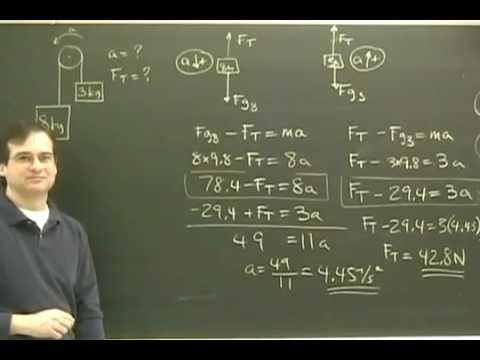
This is a unit which really many find quite difficult. To help yourself out you must learn Newton’s 1st, 2nd and 3rd law of forces. Without this knowledge you cannot succeed in explaining or reasoning out most questions. Also there is a basic principle of coplanar forces producing a resultant and therefore acceleration. It is simple as it is…
Big – Small = Resultant in the Direction of Big!
There is an easy way to remember the laws….
1) Inertia – “Objects” – don’t want to move but when moving find it difficult to stop
2) F=ma – or ratio F/m = a which is more appropriate. The acceleration on a fat person is found as the ratio of the force of the push to the mass of the person
3) Opposites – for every force their is an opposite. Fat person on chair pushing down, chair pushes up to support weight with equal and opposite force.
Simple idea of F=ma shows that Big-Small = acceleration in direction of Big.
So F = ma ............... T - mg = ma etc....
Now Playing
AS_9_2_Pully Explaination.flv
Simple idea of F=ma shows that Big-Small = acceleration in direction of Big.
So F = ma ............... T - mg = ma etc....
Now Playing
F=ma, The Mechanics Revision Song by Mr Chadwick
Mr Chadwick and his Further Maths Class singing the Mechanics Revision Song. Learn it and you can pass M1. guaranteed.
Lyrics: When the force on one side's more than the other side, ...F=ma.
If the speed seems to change in an up or down way F=ma.
If there's string, just one piece of string, that are connecting, 2 or more a thing, there is tension.
It is the same all a through the way, all a through the way, make a no mistake, the same tension.
Just resolve up the plane, down the plane, in the way of the motion.
Perpendicular forces we must-a ignore as we go.
It is Newton's whose law you must not-a ignore when there's motion.
F's miu r when you are on rough sides or inclines F=ma.Show More
Now Playing
Westminster Bridge London Eddy Currents
Great video on Westminster Bridge, shows the of ripple waves, creating an interference pattern on a bridge support.
Now Playing
Newton's Third Law Part 1 Physics Lessons
http://www.physicshelp.ca GO AHEAD and click on this site...it wont hurt. Free simple easy to follow videos all organized on our website Key Words: Newton's third 3rd law dynamics mechanics free body diagrams physics ... lesson help fbd explained action reaction applied forceShow More
Now Playing
A Common Misconception about Newton's Third Law Force Pairs (or Action-Reaction Pairs)
Just because two forces are equal in magnitude and opposite in direction ...doesn't make them a Newton's Third Law Force Pair - this video proves it with a book resting on a table. The force normal (up) and the force of gravity (down) acting on the book do satisfy that magnitude-and-direction relationship, but they're not a Third Law Force Pair, because both forces act on the same object, the book, and Third Law Force Pairs always act on two different objects. The book's actual force pairs are: the table's upward push on the book pairs with the book's downward push on the table, and the Earth's downward pull on the book (the force of gravity) pairs with the book's upward pull on the Earth.
0:00 Intro, and drawing the free body diagram 1:02 Why the Force Normal and Force of Gravity aren't a Newton's Third Law Force Pair 1:37 Finding the actual force pairs
AP Physics 1, Topic 2.3 Newton's Third Law 2.3.A.1: "Newton's third law describes the interaction of two objects in terms of the paired forces that each exerts on the other."
AP Physics C: Mechanics, Topic 2.3 Newton's Third Law 2.3.A.1: "Newton's third law describes the interaction of two objects or systems in terms of the paired forces that each exerts on the other."
Cambridge International A Level Physics (9702), Topic 3.1 Momentum and Newton's laws of motion 3.1.5: "state and apply each of Newton's laws of motion."
IB Physics, A.2 Forces and momentum A.2 (Understandings) [Newton's Laws]: "Newton's three laws of motion."
JEE Main, Unit 3 Laws of Motion "Force and inertia, Newton's first law of motion, momentum, Newton's second Law of motion, impulse, Newton's third Law of motion."
NEET, Unit 3 Laws of Motion "Force and inertia, Newton's First law of motion; Momentum, Newton's Second Law of motion, Impulses; Newton's Third Law of motion."
Ontario Physics SPH3U, Strand C Forces C3.3 (SPH3U): "state Newton's laws, and apply them, in qualitative terms, to explain the effect of forces acting on objects."
Ontario Physics (SPH4C), Strand B Motion and Its Applications "B3.4 (SPH4C): state Newton's laws, and apply them qualitatively and quantitatively to explain the motion of an object in one dimension"
Australian Curriculum Physics, Unit 2: Linear Motion and Waves ACSPH063: "Newton's Three Laws of Motion describe the relationship between the force or forces acting on an object, modelled as a point mass, and the motion of the object due to the application of the force or forces."
MCAT, Content Category 4A: Translational Motion 4A (PHY topic list) [Newton's Third Law]: "Newton's Third Law, forces equal and opposite."
Gaokao (China), Compulsory Module 1, Topic 1.2 Interactions and Laws of Motion C1.2.3: "Through experiments, explore the relationship between an object's acceleration and the force(s) acting on it and its mass. Understand Newton's laws of motion and use them to explain phenomena and solve problems in daily life. Through experiments, understand apparent overweight and weightlessness."Show More
Permanent link to this article: https://www.animatedscience.co.uk/a-level-physics-topics/4-ks5-mechanics-and-materials/9-motion-and-force