This unit depends on an ability to explain and understand force extension and YM graphs. It is one of the easy topics but also easy to drop marks if you don’t learn the graphs. Also take care of your areas and units as mm don’t convert well to m when you square them for an area calculation!
This video explains how springs behave in parallel and in series for A Level Physics.
If you understand how one spring extends when a load is applied you can then extend ...this knowledge to investigate combinations of springs in parallel and series. This also has many similarities to the way that combinations of capacitors behave when in a circuit.
Thanks for watching,
Lewis
This video is recommended (although not always mentioned explicitly) for anyone studying A Level Physics in the following exam boards: AQA CIE Edexcel Edexcel IAL Eduqas IB OCR A OCR B WJEC
_____________________________________
MY PHYSICS WEBSITES Find even more videos organised by exam board and topic at:
MY YOUTUBE CHANNEL Your support in watching this video has been invaluable! To contribute towards the free videos on YouTube, make a small donation at: ► https://www.paypal.me/physicsonline
Hooke’s Law Springs in Series and Parallel Worked Example
9702/11/M/J/13 # 23
Now Playing
Hysteresis AQA Alevel physics
Hysteresis and how you can define it using graphs
AQA A level specification - post 2015
Music: TheFatRat - Unity
Now Playing
Stretching an Elastic band
An elastic band is stretched by hanging a series of 100g masses from it. The band is first of all laden by adding masses. The masses are then removed one ...at a time. A ruler allows measurements to be taken and a hysteresis curve may be plotted. Careful observation will show that the band continues to grow slightly after each mass has been added.Show More
Now Playing
Stress–Strain Curve Explained | Mechanical Properties of Solids | Class 11 Physics | AASOKA
Stress–Strain Curve Explained | Mechanical Properties of Solids | Class 11 Physics | AASOKA
In this video, we clearly explain the Stress–Strain Curve from the chapter Mechanical Properties of Solids ...(NCERT Class 11 Physics). Learn how materials behave when external force is applied and understand important concepts like elastic limit, yield point, ultimate stress, and fracture point.
This topic is essential for CBSE Class 11 Physics, competitive exams, and strengthening your basics for Class 12 as well. The explanation is easy, visual, and perfect for students preparing for school exams, JEE, NEET, and Board exams 2025–26.
Please like, comment and subscribe to our channel.Show More
Now Playing
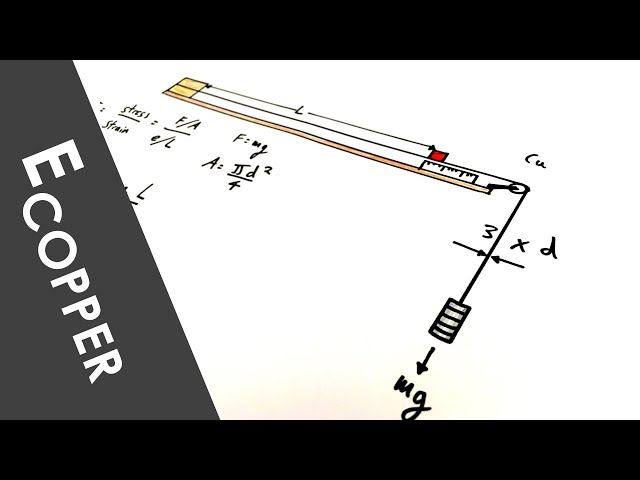
Young's Modulus of Copper - PRACTICAL - A Level Physics
In this video I go through an AQA Physics A Level Required Practical that uses a Young's Modulus experiment to calculate the Young's Modulus of copper wire. (This is AQA ...Required Practical 4.) This is also the OCR A Level Physics PAG 2.1 Practical.
This is a straight-forward way to measure the Young's Modulus of a material. Copper wire is often used as it is stretched by weights hung over the edge of the bench, with the small extension carefully measured with a ruler. Wear eye protection in-case the wire snaps.
MY YOUTUBE CHANNEL Your support in watching this video has been invaluable! To contribute towards the free videos on YouTube, make a small donation at: ► https://www.paypal.me/physicsonline