This section has some quite tricky concepts and really you need to look at the animations and play with the settings to get a feel for what happens to x when I change y etc.. You also need to learn the key diagrams as this will help your explanations. Finally look carefully at the derivations as they also will help you explain the tricky stuff.
Resources
05 Optics Student Booklet
05.1 Refraction
5.1 Refraction of light
13_1_Refraction_Practical (refractive index of a glass or a perspex block)
13_1_snells_law (practical results)
Refraction of Light (Java Applet)
Reflection and Refraction of Light Waves (Explanation by Huygens’ Principle) (Java Applet)
Refraction Animation Shows Snell’s Law (Really Good)
5.2 More about refraction
05.2 More about Refraction
13_2_Refractive_Index_Water_Prac (Refractive Index of Water)
5.3 Total internal reflection
13_3_Fiber_Optics_HTML (HTML summary)
05.3 TIR
5.4 Double slit interference
05.4 Double Slit Interference
13_4_Youngs_Slits_Practical (Hard to make this practical work but interesting method)
Diffraction of Light by a Single Slit (Java Applet)
Interference of Light at a Double Slit (Java Applet)
5.5 More about interference/ 5.6 Diffraction/ 5.7 The diffraction grating
05.6 and 5.7 Diffraction
136_Practical_Properties_of_micro (Practical investigation of properties of transverse waves
13_7_Diff_grate_prac (Investigation into diffraction 1,2,3rd order for laser beam)
13_7_Laser_Diffraction_Results (example results for red neon laser)
13.7 Spectrometer setup (Instructions)
Extra Reading…
resolving power of eye (extension for interest)
Image Formation by Converging Lenses (Java Applet)
Refracting Astronomical Telescope (Java Applet)
https://www.phet.colorado.edu/en/simulations/category/physics/light-and-radiation
Amazing Refraction Magic Trick - The Appearing Beaker
Works on refraction and refractive index being matched.
When the refractive index is the same it reverses the changes in the light pathway and it goes!Amazing Refraction Magic Trick - The Appearing Beaker
Works on refraction and refractive index being matched.
When the refractive index is the same it reverses the changes in the light pathway and it goes!
Laser Refraction of Light
This demo shows how you refract light by passing into a denser medium i.e. water. The light slows down so as c is lower than the speed of light the ...wavelength changes (reduces) and it interacts with the medium differently.
Refraction = slowing or speeding up of waves in another medium.
Change of angle can happen when the light enters at an angle which is not at 90 degrees to the normal.Show More Refraction and Reflection of Laser Light
This is a simple video to show the principle of the refraction of light and also the reflection of light using laser monochromatic light. You can clearly see that the ...light changes direction inside the prism or slows down. This is the idea of "refraction". It turns in towards the normal then away as it exits. The pathway is a constant refraction as the density is even throughout. This is not always the case for example in water the pressure changes cause curved refraction, as it the same effect with seismic waves travelling through the Earth. Interesting as well to see something which students often miss as the reflected ray on the surface of the block or the TIR or totally internally reflected rays from the internal surface of the prism.Show More Reflection and Refraction
This movie shows refraction, reflection, TIR with prisms.
Dispersion of Laser light
Amazing fun, with lasers
Neon Spectral Images AS AQA Physics
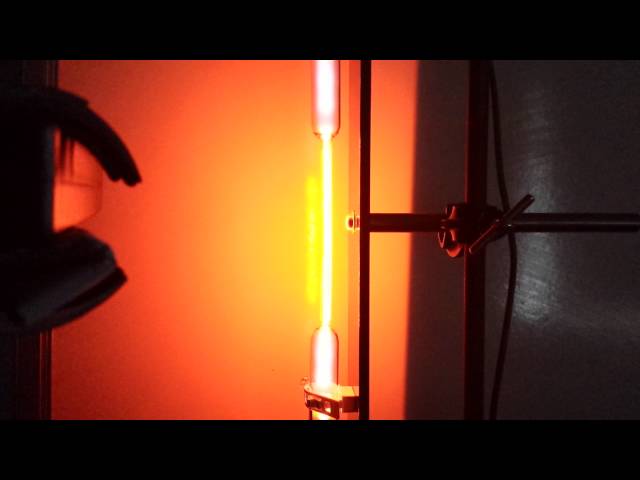
Spectral lines shown on a spectroscope from a neon geissler tube. This is a great quantum effect!
Spectral Absorption (for A-Level Physics)
When the energy gap between two molecular energy levels is exactly the same as the photon energy of an incident beam of light, some of the incident light will be ...removed from the beam. On the single-molecule level, the energy of an absorbed photon drives an
absorption transition, a nearly instantaneous process that causes the molecule to jump from its ground state to an excited state. Accordingly, the intensity of the light that is transmitted through a solution can be used to determine how many molecules are present in the solution per unit volume.Show More Refraction of Light - Introduction | Infinity Learn
Why does Refraction occur? | Don't Memorise
Total Internal Reflection and Critical Angle - A Level Physics
This video introduces and explains total internal reflection and its relationship with the critical angle for A Level Physics.
Total internal reflection occurs when light reflects off of the boundary between ...two mediums. Where light gets refracted such that the angle of refraction is greater than the angle of incidence, at some angle, the light will be refracted at an angle of 90 degrees and is reflected instead. The smallest angle of incidence that this occurs at is called the critical angle.
Thanks for watching,
Lewis
This video is recommended for anyone studying A Level Physics in the following exam boards:
AQA
CIE
Edexcel
Edexcel IAL
Eduqas
IB
OCR A
OCR B
WJEC
_____________________________________
MY PHYSICS WEBSITES
Find even more videos organised by exam board and topic at:
GCSE Physics Online
► https://www.gcsephysicsonline.com
A Level Physics Online
► https://www.alevelphysicsonline.com
MY YOUTUBE CHANNEL
Your support in watching this video has been invaluable! To contribute towards the free videos on YouTube, make a small donation at:
► https://www.paypal.me/physicsonline
FOLLOW ME
► https://www.youtube.com/physicsonline?sub_confirmation=1
► https://www.instagram.com/physicsonline/
► https://www.facebook.com/gcseandalevelphysicsonline
#waves #alevelphysics #physicsonlineShow More Optical Fibres - A Level Physics
This video explains how optical fibres (or optical fibers if you're American) work for A Level Physics.
Optical fibres use total internal reflection in order to send information. A light signal ...is sent down an optical fibre which can be received quite a distance away. The signal isn't perfect because different light rays travel different distances - this is called modal dispersion. The signal is put through a filter in order to get the original signal back out.
Thanks for watching,
Lewis
This video is recommended for anyone studying A Level Physics in the following exam boards:
AQA
CIE
Edexcel (don't need to know details)
Edexcel IAL
Eduqas
IB
OCR A
OCR B
WJEC
_____________________________________
MY PHYSICS WEBSITES
Find even more videos organised by exam board and topic at:
GCSE Physics Online
► https://www.gcsephysicsonline.com
A Level Physics Online
► https://www.alevelphysicsonline.com
MY YOUTUBE CHANNEL
Your support in watching this video has been invaluable! To contribute towards the free videos on YouTube, make a small donation at:
► https://www.paypal.me/physicsonline
FOLLOW ME
► https://www.youtube.com/physicsonline?sub_confirmation=1
► https://www.instagram.com/physicsonline/
► https://www.facebook.com/gcseandalevelphysicsonline
#waves #alevelphysics #physicsonlineShow More Young's Double Slit Experiment - A Level Physics
The Double-Slit Experiment
DR. QUANTUM - DOUBLE SLIT EXPERIMENT
THIS BBC DOC IS PERFECT:
https://www.youtube.com/watch?v=EAv0hS34muA
A SHORT LESSON IN THE BASICS OF QUANTUM PHYSICS
Quantum physics is the study of the interaction of atoms and the microscopic universe.
Quantum Physics gave us TV ...(the image is formed by electrons being shot at a layer of phosphorous on the inside of the screen.)
Quantum also gave us microwave ovens, lasers, cell phones, nuclear energy, and the atom bomb.
In the early days Quantum researchers did various experiments on electrons, or the tiny particles that seem to fly around the nucleus of an atom and of which everything in our present existence is made.
The results of these experiments caused the world of physics to question many of its laws, and even had Einstein losing it over what it all meant.
Neils Bohr, Wolfgang Pauli, Werner Heisenberg, John Bell, and Erwin Schrodinger who made achievements in Quantum physics were all given Nobel Prizes.
Unless Nobel Prizes are given for myths or to idiots, the experiments listed below are definitely worth our contemplation.
a) The most important experiment was known as the Double Slit Experiment.
This experiment was simply done; if you take a gun and shoot black sand, through 2 slits on a metal plate with a white wall behind it you will get an image that looks like this on the white wall:
I I
If you point a flashlight through the 2 slits you will get an image on the wall that looks like this:
I I I I I I I I
This is called an interference pattern and you may notice how the lines in the middle are stronger than the ones on the edges as is common in all experiments done with light waves - water ripples are similar to light waves.
Everything in our present existence is made of either matter (solid particles) or light.
This experiment is a basic yet very effective method of differentiating between waves and what is composed of particles -- or matter - on the atomic level.
Back to electrons: when scientists shot electrons through the plate with the double slit the result was that of a wave
I I I I I I I I
This drove the scientific community nuts as they thought that electrons were particles made of matter.
After much controversy, theories as to why, and repeated experiments scientists decided to watch exactly what the electrons were doing as they passed through the 2 slits. The result that followed turned the world of physics around.
When the electrons were observed the result was:
I I
matter
When the observation device was switched off the result was again:
I I I I I I I I
a wave
Electrons would switch from waves into matter particles instantly and only when scientists were observing them.
Did the electrons seem to know somehow when they were being watched and would snap into being particles of matter and "behave" only when they were being observed?
For anything on the planet to be switching back and forth from waves into matter is impossible. - It does not compute.
This phenomenon is now called in Quantum "The Collapse of a Wave."
The Collapse of a Wave has been one of the most startling discoveries of Quantum Physics.
Physicists have a stream of theories, but this simple yet unexplainable experiment declared to humanity that everything we are looking at-- as completely irrational as it may seem - on the quantum level - turns into reality or solid form - only when it is observed.
No one really knows what is going on down there; there is no real explanation possible.
Without the observer - nothing is solid.
Einstein grew increasingly troubled by the "Collapse of a Wave" and toward the end of his life at one point during a heart-to-heart talk with physicist Abraham Pais asked "Do you really believe the moon exists only when I look at it?"
Does everything only exist when it is being observed?
This would mean consciousness is creating what we see with our eyes. Many theories have been given in regards to the Collapse of a Wave; the most popular being co-dimensions existing at the same time and electrons are switching back and forth between them.
Another is the existence of a sort of "fabric" that connects everything in the universe. When consciousness "observes" the fabric then the solid image forms ...
Presently all quantum physics equations now have the "observer" factor added.
Stephen Hawkings recently said that whoever can decipher Quantum has deciphered the language of the universe.Show More Proving Young's Double Slit Interference Equation - IB Physics
Lecture on using the double slit equation to solve problems here: https://www.youtube.com/watch?v=dI64_h-Gdxs
I give a derivation of Young's double slit formula. The double slit formula is used to find the pattern ...that the interference of two light waves create when they pass through double slits in a diffraction grating.
Young's double slit formula connects the distance between two slits in a diffraction grating, the distance from the diffraction grating to the wall, the distance between points of maximum constructive interference, and the wavelength of light.
0:00 What the Equation is Predicting
1:33 Path Difference, and Constructive and Destructive Interference
5:26 Drawings of Double Slit Experiments are Exaggerated
5:40 The Visual Pattern of Constructive and Destructive Interference
6:01 Proving the EquationShow More Solving Problems with Young's Double Slit Interference Equation - IB Physics
Now that we have proved Young's Double Slit Interference Equation, we can use it to solve for missing variables in the double slit experiment like the length between maxima, distance ...between the wall and the diffraction grating, the distance between the double slits, and the wavelength of the light.
Proof of Young's Double Slit Formula: https://www.youtube.com/watch?v=uf1FuO8ONWs
0:00 Review of Young's Double Slit Equation
1:32 Example Problem 1
2:48 Example Problem 2
3:45 Example Problem 3
4:57 Example Problem 4Show More Diffraction Gratings | A-level Physics | OCR, AQA, Edexcel
Diffraction Gratings in a Snap!
Unlock the full A-level Physics course at http://bit.ly/2KciSK5 created by Elisavet, Physics expert at SnapRevise.
SnapRevise is the UK’s leading A-level and GCSE revision & exam ...preparation resource offering comprehensive video courses created by A* tutors. Our courses are designed around the OCR, AQA, SNAB, Edexcel B, WJEC, CIE and IAL exam boards, concisely covering all the important concepts required by each specification. In addition to all the content videos, our courses include hundreds of exam question videos, where we show you how to tackle questions and walk you through step by step how to score full marks.
Sign up today and together, let’s make A-level Physics a walk in the park!Show More Measuring Wavelength of Light with a Diffraction Grating - PRACTICAL - A Level Physics
Title | What to do | Site |
Converging Mirror Lab | Image in concave mirror | PhysAviary |
Image formation in curved mirrors | Images in mirrors | Geobra |
Image formation in curved mirrors | Images in mirrors | Geobra |
Image formation in plane mirrors | Images in mirrors | Geobra |
Images in mirrors | Mirrors | Sim bucket |
Mirrors | Images | Boston Uni |
Mirrors and time | Least time | Boston Uni |
Name That Image | Figure out image location/type of mirror | Physics Classroom |
Optics Bench – Mirrors | Use the bench to investigate images | Physics Classroom |
Plane Mirror – How Tall? | Images | Boston Uni |
Reflection and the Role of Time | Least time | Boston Uni |
Who Can See Who | Game to use mirrors | Physics Classroom |
Reflection, Time, and the Law of Reflection | Least time | Boston Uni |
Refracting astronomical telescope | Telescopes | Fendt |
Total Internal Reflection | TIR | Boston Uni |
The Way a Mirror Works Lab (Concave) | Curved mirrors – concave | PhysAviary |
The Way a Mirror Works Lab (Concave) | Curved mirrors – convex | PhysAviary |
The Way a Mirror Works Lab (Plane) | Reflection analogy | PhysAviary |
Reflection and refraction | Reflection/refraction | Geobra |
Reflection and refraction of light | Reflection and refraction | Fendt |
Least Time Principle | Drowned swimmer analogy | Physics Classroom |
Refraction | Investigate effect of angle, media | Physics Classroom |
Rainbow formation | Refraction | Geobra |
Rainbow formation 3D | Refraction | Geobra |
Refraction | Snell’s Law | Boston Uni |
Refraction and the Role of Time | Least time | Boston Uni |
Refraction in a Block | Snell’s Law | Boston Uni |
Refraction Lab | Refraction | PhysAviary |
Refraction, the Role of Time, and Snell’s law | Least time | Boston Uni |