This topic a meaty one with plenty of learnt facts and calculations to build on the facts. You must write notes to help you remember the key points. Also try out the virtual links and further reading. However, don’t get too carried away with all the music stuff which can go pretty deep.
Polarisation of Light and LCD Screens - AQA A Level Physics
This simple video shows you how a polariser works on a sheet of thin plastic.
Also how LCD screens emit light which is also polarised.
You can see how I can block ...the light by rotating the plastic sheets with drawn black lines by 90 degrees.Show More
Now Playing
Polarisation of Waves - A Level Physics
In the video I explain the polarisation of waves (including the polarisation of light) for A Level Physics.
Only transverse waves can be polarised, this video explains why. It also ...shows why sunglasses are known as 'polaroids' and how you can test this yourself on a sunny day.
MY YOUTUBE CHANNEL Your support in watching this video has been invaluable! To contribute towards the free videos on YouTube, make a small donation at: ► https://www.paypal.me/physicsonline
MY YOUTUBE CHANNEL Your support in watching this video has been invaluable! To contribute towards the free videos on YouTube, make a small donation at: ► https://www.paypal.me/physicsonline
In this video I explain two more properties of waves: amplitude and intensity, for A Level Physics.
This catches lots of people out. If you double the amplitude of a wave ...you give it four times as much energy, this leads on to the relationship between amplitude and intensity of a wave.
Thanks for watching,
Lewis
This video is recommended for anyone studying A Level Physics in the following exam boards: AQA CIE Edexcel Edexcel IAL Eduqas IB OCR A OCR B WJEC
_____________________________________
MY PHYSICS WEBSITES Find even more videos organised by exam board and topic at:
MY YOUTUBE CHANNEL Your support in watching this video has been invaluable! To contribute towards the free videos on YouTube, make a small donation at: ► https://www.paypal.me/physicsonline
This is a typical quick classical Physics demo of a slinky to show longitudinal and transverse waves. I have put a scale of 0.5m on the wavelength so you can ...work out a whole wavelength. Also you have a small amplitude scale to show the energy of the wave.Show More
Now Playing
Chladni Plate with AC Transformer Standing Wave
Great idea to show a standing wave for AS Physics. This one uses an AC signal and transformer with magnet instead of signal generator
Amazing and simple plate vibration with an ...AC oscillator signal generator. The large motion of the plate is where "resonance" occurs and the semolina is moved more and then moves away this is an antinode. The "nodes" are where the waveform is stationary and a point of inflection. You can see how different standing waves fit onto the plate to produce the pattern, you could work out the speed of sound of travel through the material using this setup and a ruler if you know the frequency, which I did!
This experiment is all about how a wave can be created by passing an AC current through a wire. If the standing wave is only 1/2 of a wavelength you ...can calculate the mass per unit length of the wire.
Clearly this will vary depending on the thickness of the wire used.
It is such a nice and simple practical. The AC current makes the force on the wire change directions according to Flemings Left Hand rule. So you end you end up with an oscillation with a frequency of 50HzShow More
Now Playing
Phase shift of Pendulum SHM and Circular Motion
Very cool SHM experiment. Watch to the end to find out the length of the pendulum. Use the time on the video to compare.
If you work out the cycle time ...from 1min to 1 min 14s. The ball spins around 10 times. This gives a period T = 1.4s
The string is 0.43cm long which gives a theoretical period time T = 1.32s
Interestingly if you work out the expected length to match the pendulum is should be 48.7cmShow More
Now Playing
Ripple Tank and Waves
Now Playing
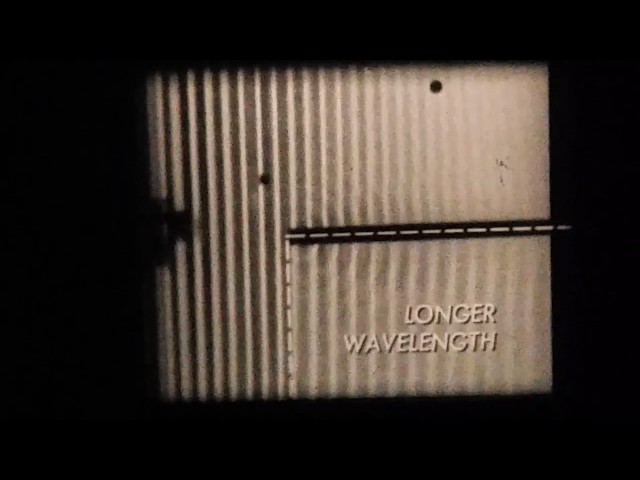
Ealing Film-Loops 80-234 - Refraction of Waves in a Ripple Tank
Ealing Film-Loops 80-234 - Refraction of Waves in a Ripple Tank
This film-loop was recovered mid-2016 from Missouri S&T's surplus warehouse and played on a Technicolor 810 instant movie projector designed ...for such 8mm film-loop cartridges. For images of the film-loop cartridge and the descriptive text on the box it came in, please wait until the end of the video. Presented for educational or informational purposes only, for those interested science, pedagogy, bygone educational technology, archival films, ephemeral films, or educational films.Show More
Now Playing
Ripple Tank 06 Angled Refraction
See all 33 of the ripple tank / 2D wave tank videos linked below...
Demonstration of standing waves on a string. How the standing waves are generated, harmonics and more is explained here. See my next video for the explanation: Standing Waves ...Part II: Explanation @James Dann for ck12.org CC-BY-NC-SAShow More
Now Playing
Standing Waves Part II: Explanation
The derivation for the harmonic frequencies of standing waves on a string attached at both ends. By James Dann for ck12.org CC-BY-NC-SA
Now Playing
How to Read an Oscilloscope - GCSE and A Level Physics
This video explains how to read an oscilloscope. Oscilloscopes are often quite old and can be tricky to decipher. However it's not as bad as you think!
Oscilloscopes essentially displays a ...graph that changes in real time. The y-axis is potential difference (voltage) and the x-axis is time. An alternating current source will produce a sinusoidal wave signal on an oscilloscope whereas a direct current will produce a flat line.
For an alternating current source, the distance between two peaks is the time period of the wave, not the wavelength. The time base and the voltage scale of the oscilloscope can be altered in order to see the waveform more clearly.
Thanks for watching,
Lewis
This video is not specifically relevant but recommended for GCSE Physics 9-1 in the following exam boards: AQA (including Trilogy) Edexcel WJEC
_____________________________________
MY PHYSICS WEBSITES Find even more videos organised by exam board and topic at:
MY YOUTUBE CHANNEL Your support in watching this video has been invaluable! To contribute towards the free videos on YouTube, make a small donation at: ► https://www.paypal.me/physicsonline
AQA unit 1 past paper question on oscilloscopes. Including a question on timebase and frequency.
Now Playing
Cathode Ray Oscilloscope - IGCSE and A level Physics
A brief video that explains how the CRO works and how you can use it to work out the frequency and time-period of a wave.
Now Playing
Chladni Plate Standing Waves
This is a simple video to show how vibrations from a signal generator make a plate oscillate or move up and down. However, there are places there there is a ...large amplitude and places where the amplitude is zero. This is called a "standing wave" like you would see on a string. This causes the semolina grains to either move a lot or not at all, at the nodus (knot) which you cannot see on the plate!Show More
Now Playing
Non Newtonian liquid in 1/8 speed
Now Playing
Non Newtonian fluid Part IV
This is a simple exp using 12.5g of Cornstarch / 10ml of water + some drops of food colouring. Place clingflim over the speaker (unless you want ruin it) then ...apply frequency. I used a Lascels generator on max amplitude and a large speaker from Maplin labelled as 10W 8 Ohms TR-150F-R about 15cm diameter. The frequency that things start to really happen is about 36Hz. Try spooning the liquid away from the central dome as shown in the last video of the series.Show More
Now Playing
Non Newtonian fluid Part III
This is a simple exp using 12.5g of Cornstarch / 10ml of water + some drops of food colouring. Place cling flim over the speaker (unless you want ruin it) ...then apply frequency. I used a Lascels generator on max amplitude and a large speaker from Maplin labelled as 10W 8 Ohms TR-150F-R about 15cm diameter. The frequency that things start to really happen is about 36Hz. Try spooning the liquid away from the central dome as shown in the last video of the series.Show More
Now Playing
Non Newtonian fluid Part II
This is a simple exp using 12.5g of Cornstarch / 10ml of water + some drops of food colouring. Place clingflim over the speaker (unless you want ruin it) then ...apply frequency. I used a Lascels generator on max amplitude and a large speaker from Maplin labelled as 10W 8 Ohms TR-150F-R about 15cm diameter. The frequency that things start to really happen is about 36Hz. Try spooning the liquid away from the central dome as shown in the last video of the series.Show More
Now Playing
Rubens tube
OG Jphelpz plays the reubens tube. This is a great demonstration to show how a standing wave formed as two progressive waves interfere and create areas of cancellation and reinforcement. ...However, this is not a single tone and the beat of the music has an effect which varies on the gas. Look for the beat changes.
Invented by German physicist Heinrich Rubens in 1905, it graphically shows the relationship between sound waves and sound pressure, as a primitive oscilloscope.
In the standing wave single tonal form. If a suitable constant frequency is used, a standing wave can form within the tube. When the speaker is turned on, the standing wave will create points with oscillating (higher and lower) pressure and points with constant pressure (pressure nodes) along the tube. Where there is oscillating pressure due to the sound waves, less gas will escape from the perforations in the tube, and the flames will be lower at those points. At the pressure nodes, the flames are higher. At the end of the tube gas molecule velocity is zero and oscillating pressure is maximal, thus low flames are observed. It is possible to determine the wavelength from the flame minimum and maximum by simply measuring with a ruler.
The wavelength is found by measuring from a peak to peak which is classed as half the wavelength.Show More