28 Discovery of the Electron
This page covers discovery of the electron section of the course.
Resources
28 Discovery of Electron
28 Discovery of Electron Book
A2 Discovery of Electron Timed Assessment
A Level Physics | Cathode Rays | Crookes Railway Wheel | Crooks Paddle Wheel
William Crookes used the idea of the discharge tube to investigate these cathode rays further.
Crookes put a lightweight paddlewheel made of mica with a fluorescent coating inside a discharge ...tube.
It was in the path of the cathode rays and he found it moved when they hit it.
The paddlewheel turned in a direction away from the cathode side of the tube, suggesting that the force of the cathode rays striking the paddles was causing the rotation.
Crookes concluded at the time that this showed that cathode rays had momentum, so the rays were likely matter particles.
However, later it was concluded that the paddle wheel turned not due to the momentum of the particles (or electrons) hitting the paddle wheel but due to the radiometric effect.
When the rays hit the paddle surface they heated it, and the heat caused the gas next to it to expand, pushing the paddle.
This was proven in 1903 by J. J. Thomson who calculated that the momentum of the electrons was not enough to move them by itself.
All this experiment really showed was that cathode rays were able to heat surfaces.
However, it was still more incredible exploratory work to find out more about the electron.Show MoreA Level Physics | Cathode Rays | Crookes Railway Wheel | Crooks Paddle Wheel
William Crookes used the idea of the discharge tube to investigate these cathode rays further.
Crookes put a lightweight paddlewheel made of mica with a fluorescent coating inside a discharge ...tube.
It was in the path of the cathode rays and he found it moved when they hit it.
The paddlewheel turned in a direction away from the cathode side of the tube, suggesting that the force of the cathode rays striking the paddles was causing the rotation.
Crookes concluded at the time that this showed that cathode rays had momentum, so the rays were likely matter particles.
However, later it was concluded that the paddle wheel turned not due to the momentum of the particles (or electrons) hitting the paddle wheel but due to the radiometric effect.
When the rays hit the paddle surface they heated it, and the heat caused the gas next to it to expand, pushing the paddle.
This was proven in 1903 by J. J. Thomson who calculated that the momentum of the electrons was not enough to move them by itself.
All this experiment really showed was that cathode rays were able to heat surfaces.
However, it was still more incredible exploratory work to find out more about the electron.Show More Thermionic Emission Explained - The Cathode Ray Tube - Physics
When a metal wire is heated in a vacuum, electrons are 'boiled' off the surface. This effect is called thermionic emission.
Discover more physics tutorials at:
https://gcsephysicsninja.comHow does the electron gun work? Thermionic Emission and Particle Acceleration - A Level Physics
What's the speed of an electron accelerated through 5000V? An electron gun works by thermionic emission and particle acceleration. The Electron gun is essentially a linear accelerator. ...In this video IShow More Episode 23 Electrons
Amazing Eureka Physics video series from 1 to 30 which through cartoon go through the amazing world of KS3 to A-Level Physics teaching with key concepts.
First released in Canada but ...still going strong!Show More Maltese Cross Electron Wave Particle Duality Exp - AQA A Level Physics
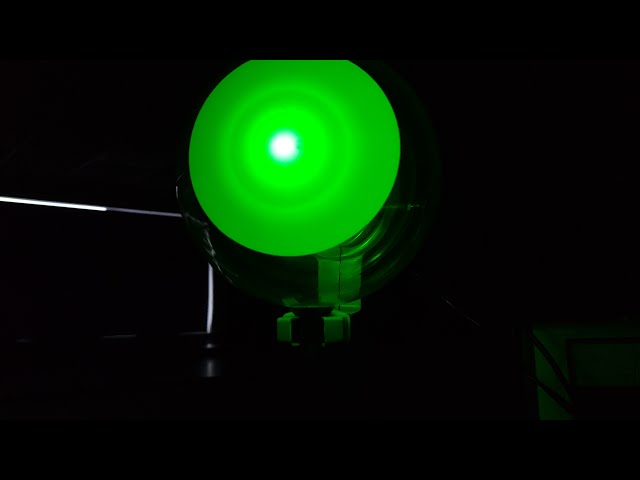
The electron gun fires a beam of electrons that spread out as they travel across through the vacuum towards the screen. In the path of the beam there is a ...metal cross. The electrons that hit the cross are stopped by the metal, but those that get past it hit a fluorescent screen at the far side of the tube which glows green when the electrons collide with it.
A sharp silhouette of the cross can be seen on the screen and this shows that the electrons travel in straight lines.
The anode voltage is a few thousand volts and the same voltage is also connected to the Maltese cross. If this voltage is increased the electrons gain more energy and so are moving faster when they hit the screen. This makes it glow more brightly. Turning up the heater voltage also makes the screen brighter because the electron gun is producing more electrons due to the hotter heater.
If you touch the front of the screen the silhouette will move because you are earthing it. Electrons that had collected on the glass flow through you to the ground.
Holding a magnet near the tube (especially near the electron gun or near the silhouette of the cross) will distort the picture showing that electron beams are affected by magnetic fields. Think about where the poles appear?
The Cloverleaf is when you take out the positive connection to the cross and the electrons build up on the cross and repel the electrons which are accelerated awayShow More Electron Diffraction De Broglie Waves and Nucleus Diameter - AQA A Level Physics
Everyone seems to be talking about Wave-Particle Duality these days, but once there was a time when nobody had even thought that particles could act like waves.
Funny that mattter is ...neither a wave or a particle as this is somthing we have made up to help us explain how matter OR stuff behaves around us.
It just helps to think of stuff as waves, as it then has a wave function which gives us some idea about how quantum Physics works which sort of explains most of the Universe, Biology and Chemistry quite well.
⇒ Since waves behave like particles, scientists wanted to know if particles could behave like waves
⇒ Diffraction is a clear property of waves, but if diffraction could be observed using particles (e.g. electrons), then this would prove that particles also behave like waves
Electron diffraction refers to the wave nature of electrons. However, from a technical or practical point of view, it may be regarded as a technique used to study matter by firing electrons at a sample and observing the resulting interference pattern.
Electron diffraction is the phenomenon resulting from the interaction between electrons and crystalline materials, producing a pattern of rings or spots that characterize the sample (Glauber and Schomaker, 1953). The De Broglie wavelength is similar to the atomic spacing.
This phenomenon occurs due to the wave-particle duality, which states that a particle of matter (in this case the incident electron) has wave properties as well as particle properties.
⇒ Since waves behaved like particles, scientists wanted to know if particles could behave like waves
⇒ Diffraction is a clear property of waves, but if diffraction could be observed using particles (e.g. electrons), then this would prove that particles also behave like wavesShow More Circular Electron Beam in Magnetic Field - A Level Physics
This is how you can work out e/m for circular beam of electrons thermionic emitted from a filament.
It uses both electric fields and mag fields and Helmholtz coils.
Perrin Tube - Electron Demo A2 AQA Mag Fields Discovery of the Electron and Charge
The stream of electrons or "cathode rays" are deflected into a Faraday cage, which is connected to an electroscope, to show that electrons have a negative charge.
It is important ...that the whole beam should enter the cylinder to avoid the production of secondary electrons by the beam striking the sides. For this reason it is more reliable to use the coils to deflect the beam than to do the experiment with a bar magnet deflecting the beam as I have done here.
You may find that the charge leaks away as soon as you remove the magnetic field that is causing the deflection. So it is best to view the effects live.
Result is to prove that cathode rays have a charge, which you can then go on to show is negative. Also that they have mass and obey the formulas used in A2 Physic for a particle moving in a B-field
Full instructions are shown here...
http://practicalphysics.org/perrin-tube-%E2%80%93-sign-electron-charge.htmlShow More E/M Fine beam Tube Exp 1 - A Level Physics
This demo shows how to balance an electric field and magnetic field for an accelerated electron to work out a charge to mass ratio.
Using Helmholtz Coils for mag field
E/M Fine Beam Tube Circular Electron Demo AQA Physics Mag Fields v 2
Amazing tube demo, leads to e/m calculation
Millikan's oil drop experiment to determine charge of an electron - Chemistry
This chemistry video for Grade 10-11 students demonstrates R. A. Millikan's oil drop experiment to calculate the charge of an electron.
Physics 34 Fluid Dynamics (2 of 24) Viscosity & Fluid Flow: Stokes' Law
Permanent link to this article: https://www.animatedscience.co.uk/a-level-physics-topics/12-ks5-turning-points/28-discovery-of-the-electron